
Loading...
Serving Green Bay, WI and surrounding areas. (920) 932-4097
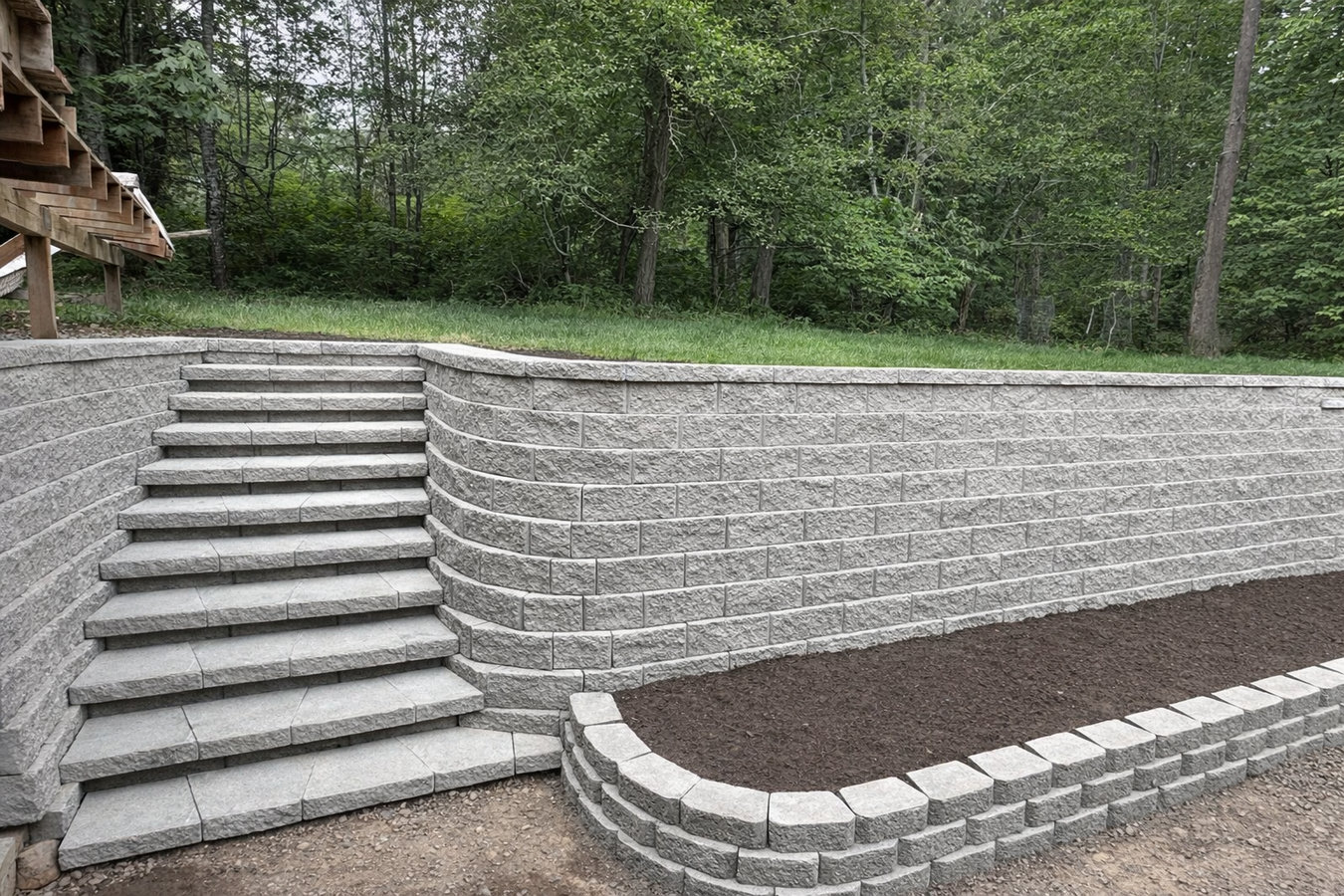
Green Bay clay soil holds water and heaves hard every winter. A properly built retaining wall - with drainage behind it and a base below the frost line - holds your slope in place for decades.
Retaining wall construction in Green Bay, WI means building a permanent structure that holds back soil on a slope so it does not erode, shift, or wash toward your foundation - most residential projects take one to three days once construction begins, and a well-built wall can last 50 years or more with minimal upkeep. Without a wall, sloped yards in Green Bay lose soil every spring during snowmelt and heavy rain, and that erosion gets worse over time.
Homeowners often call us because an old timber or railroad-tie wall has started rotting, or because water is pooling at the base of a slope after every rain. A concrete block or natural stone wall addresses both the erosion and the drainage problem in one project. If you are thinking about converting a sloped area into a flat patio or garden space, pairing the retaining wall with masonry restoration on adjacent structures can bring the whole yard together cleanly.
The University of Minnesota Extension notes that improper drainage behind a retaining wall is the leading reason walls fail within a few years of installation - a detail that matters especially in Green Bay's clay-heavy soil.
Bare patches, ruts, or small gullies forming on a sloped area after a rainstorm mean soil erosion is already underway. In Green Bay, spring snowmelt combined with heavy April and May rain can accelerate this quickly. Left alone, that eroding slope can eventually undermine nearby walkways, landscaping, or your home's foundation.
A retaining wall that has started to tilt forward or shows horizontal cracks near the middle is under more stress than it was built to handle. In Green Bay's climate, repeated freeze-thaw cycles over several winters are a leading cause of this movement. A leaning wall will not fix itself - the longer it is left, the more soil can shift and damage the area behind it.
Standing water that consistently collects at the bottom of a slope after rain or snowmelt means the drainage is not working. That saturated soil increases the pressure on any existing wall and creates a soggy, unusable corner of your yard. A properly built retaining wall with drainage behind it redirects that water before it becomes a recurring problem.
Older homes in Green Bay often have retaining walls built from treated timber or railroad ties installed 20 to 30 years ago. If the wood is soft, crumbling, or the wall is visibly separating, it has reached the end of its useful life. Replacing it with concrete block or stone gives you a solution that will not need to be rebuilt again in another generation.
We build retaining walls in concrete block, natural stone, and poured concrete depending on your site conditions, aesthetic preference, and budget. Every wall we construct includes gravel backfill and a drain channel behind it - not as an optional add-on, but as a standard part of how we build. We also handle permit applications when the City of Green Bay requires one, so you are not left navigating that process on your own.
When a failing wall also affects nearby masonry - a driveway edge, a garden border, or an existing structure - we assess it all at the same time. If you are looking to enclose more of your yard with a solid boundary, our concrete block walls service covers privacy and boundary applications beyond standard slope retention. For older walls that need reinforcement rather than full replacement, masonry restoration may be the right fit. We assess the full scope before any work begins and provide a written estimate that covers every cost.
Best for yards with an active erosion problem, a slope that drains toward the house, or a homeowner who wants to create flat usable space.
Suited for properties with failed timber, railroad tie, or block walls that have reached the end of their structural life.
Appropriate when an existing wall is structurally sound but leaning, cracking, or draining poorly behind the face.
Much of the Green Bay area sits on heavy clay soil left behind by glacial activity. Clay holds water rather than letting it drain through, which means pressure builds up behind a retaining wall much faster here than in sandier soil. That is why proper drainage installation - gravel backfill and a perforated drain pipe - is not optional in this region. The ground also freezes to a depth of around 48 inches in a typical Green Bay winter. Any wall whose base does not account for that frost depth will heave and tilt as the ground moves, no matter how well the face looks on day one.
Many established neighborhoods on Green Bay's east and west sides - and surrounding communities like Wrightstown and De Pere - have homes built in the 1950s through 1980s with timber walls that are now at the end of their life. Replacing those walls with concrete block is one of the most common projects we handle in this area. USDA soil conservation guidance confirms that heavy clay soils require specific drainage measures that contractors working only in warmer or sandier regions may not be accustomed to addressing.
We respond within 1 business day. Tell us about the slope, any existing wall, and what you are hoping to accomplish. We schedule a free on-site visit - a written estimate requires seeing the site, not guessing from a description.
A mason walks the yard, checks soil conditions, measures the area, and assesses drainage. You receive a written estimate that breaks down materials, labor, drainage work, and any permit costs before any commitment is made.
If a city permit is required, we handle the application. Wisconsin law requires utility locating before any digging - we coordinate that as part of the project. Excavation goes below Green Bay's frost line to set a stable foundation.
The wall goes up course by course with gravel backfill and drainage installed as we go. Most residential walls are complete in one to three days. We walk the finished wall with you, explain basic maintenance, and answer any questions before we leave.
We visit the site, assess your slope, and give you a written quote. No obligation, no follow-up pressure. Response within 1 business day.
(920) 932-4097Every wall we build is set with a foundation depth that accounts for Green Bay's frost penetration - not a standard depth copied from a warmer climate. That is the single biggest factor in whether a wall holds for 50 years or starts tilting after the first few winters.
Gravel backfill and a perforated drain channel behind the wall are not optional line items - they are built into every wall we construct. In Green Bay's clay-heavy soil, skipping this step is the leading reason walls fail within a few years of installation.
The City of Green Bay requires permits for walls above certain heights, and navigating that process is something many homeowners dread. We handle the application, coordinate the inspection, and keep you updated - you do not have to deal with the building department directly.
Green Bay Concrete and Masonry has been working in Brown County long enough to know the clay soil conditions, frost depth requirements, and drainage patterns specific to this area. That local knowledge shows up in how we scope and build every project.
A retaining wall is one of those projects where the work that matters most happens underground - before a single block is visible. Any experienced retaining wall contractor prioritizes the foundation and drainage because that is where the long-term performance of the wall is determined.
If an older retaining wall needs more than replacement, masonry restoration can bring deteriorated block or stone back to sound condition.
Learn MoreConcrete block wall construction for property boundaries, privacy screening, and structural yard division beyond standard retaining applications.
Learn MoreGreen Bay's construction season is short. The sooner you reach out, the better your chances of landing on a good crew's schedule before the rush hits.